How businesses abroad run support around the clock with AI agents
Quick answer
The companies getting good results automate 40% to 70% of contacts and keep people for the rest. The industry average return is about $3.50 for every $1 spent, paid back in three to six months. The ones that try to automate everything end up reversing it. Around 75% of companies that rolled out customer-facing AI agents later pulled them back.
Key numbers
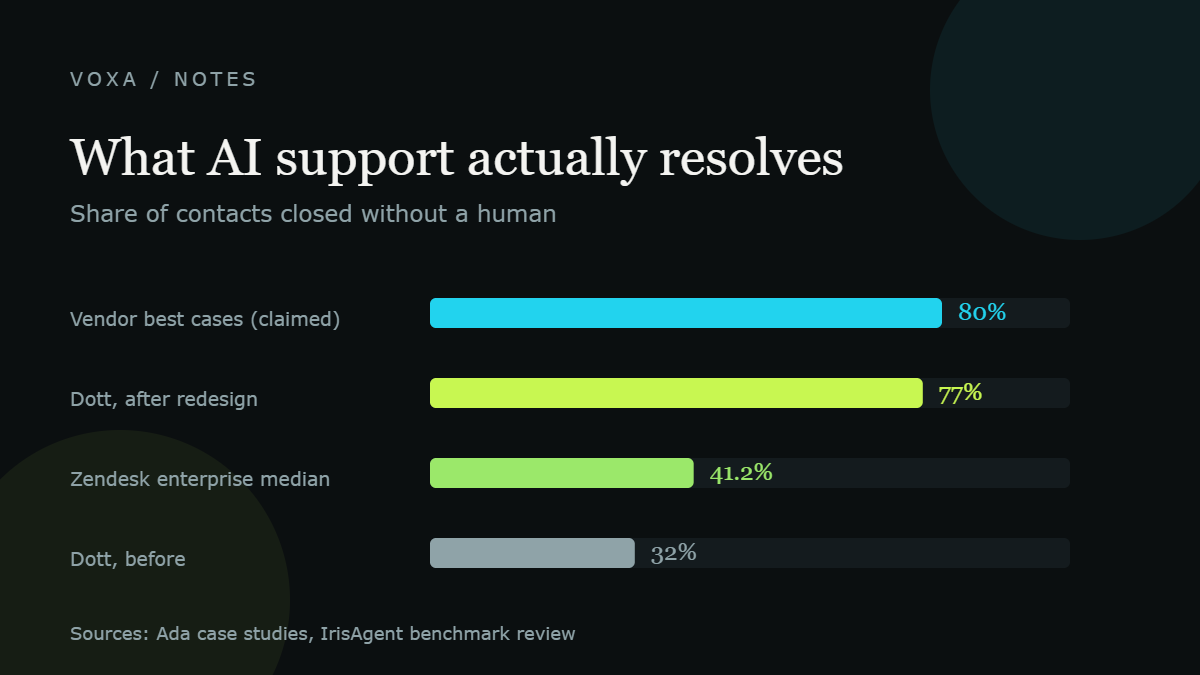
- Dott: automated resolution rate from 32% to 77%
- Loop Earplugs: CSAT 80% and 357% ROI; IPSY: 943% ROI
- GoFundMe: CSAT up 20%; Cebu Pacific: CSAT up 50%
- Zendesk enterprise median deflection: 41.2%, against vendor claims of up to 80%
- Industry average return: about $3.50 per $1 spent, payback in 3 to 6 months
- Voice AI: about 19% of inbound contact centre volume, up from 6% in 2024
What a good result actually looks like
Forget the vendor demos. Here are published customer numbers from companies in Europe and the US that run AI agents in front of real customers.
| Company | Where | Published result |
|---|---|---|
| Dott (scooters and bikes) | Europe | Automated resolution rate went from 32% to 77% |
| Green Feather Online | Malta | Automated resolution up 37 percentage points in five months |
| Loop Earplugs | Belgium | CSAT 80% and 357% return on the AI investment |
| IPSY | US | 943% return on its generative AI investment |
| GoFundMe | US | Customer satisfaction up 20% |
| Cebu Pacific | Philippines | Satisfaction up 50% after moving from a rule-based bot to a generative agent |
| Deezer | France | About 30% automated resolution on day one, AI handling 85% of contacts, people kept for sensitive cases |
| Tango Card | US | 6.7x return in the first year |
Two things stand out. First, none of them claim 100%. Second, the winners treat AI as a product decision, not a cost-cutting project. Dott more than doubled its resolution rate by deciding the agent had to handle certain journeys end to end, then fixing the product pages that confused it.
The honest benchmark
Vendors publish deflection rates as high as 80%. Independent data from enterprise Zendesk accounts puts the median at 41.2%. The gap is not fraud, it is selection: vendors show their best accounts, enterprises show the average.
What the average looks like across published figures: a return of roughly $3.50 per $1 spent, with three to six months to payback. Salesforce expects half of all service cases to be resolved by AI by 2027, up from about 30% in 2025. The highest-performing contact centres run a three-layer model: AI handling 40% to 60% of volume outright, AI helping human agents on the calls they take, and people reserved for complex cases. Teams using both layers report 25% to 50% shorter handling time. Voice AI now takes about 19% of inbound contact centre volume, up from 6% in 2024.
Why so many roll it back
Gartner scored 432 customer service AI use cases. A quarter produced a positive return, a quarter lost money, 11% broke even, and 42% were unclear because the company could not measure them. A survey of more than 600 customer experience leaders found 70% had adopted AI, only 2% saw real value, and 75% rolled back customer-facing agents after launch.
Klarna is the famous example. Two-thirds of chats went to AI and resolution time dropped from 11 minutes to under 2 minutes, which is a genuine win. But its support costs still rose from $42 million to $50 million year over year, and in May 2025 it started hiring support staff again. The company now runs a hybrid model with a guaranteed route to a human.
The failures cluster in three places: letting the agent make judgement calls it should not make, not measuring what it actually closed, and hiding the human option.
How a small business copies this
Start with your own inbox, not with a vendor. List the ten questions you answer most often. If eight of them have the same answer every time, that is your first automation, and it is worth real money.
Let the agent handle the first reply and the collection of details. Keep the decision, the refund and the exception with a person. Track one number weekly: the share of conversations closed without a human touching them. If it climbs and complaints do not, you have a working deployment. If complaints climb, pull the scope back.
And keep the human door visible on every screen. Every company with a good result kept it.
Where these numbers come from
Plain links to the original sources, so you can check every figure yourself. We do not take sponsorships and we do not get paid for these links.
- Ada: published AI customer service case studies, including Dott, Loop Earplugs, IPSY and GoFundMe
- IrisAgent: AI customer support statistics 2026, including the Zendesk median and Gartner findings
- Fini: the three-layer support model and Klarna, both halves of the story
- CX Dive: Klarna recruits humans again for customer service
- Klarna: AI assistant handles two-thirds of customer service chats in its first month
Common questions
Do customers actually like talking to AI support agents?
Published satisfaction numbers are mixed. GoFundMe reported a 20% rise and Cebu Pacific 50%, while three quarters of large companies pulled back customer-facing agents at least once. Satisfaction tends to hold when the AI solves the issue and a human is easy to reach, and falls when it cannot.
How much does AI customer support cost a small business?
Entry-level support agents start around $29 a month for low volumes and scale with conversations after that. The bigger cost is deciding what the agent is allowed to do, and writing your policies down so it can answer correctly.
How long before it pays for itself?
Across published enterprise figures, about three to six months, with roughly $3.50 returned per $1 spent. A small business with a repetitive inbox usually sees the time saving faster than a large one.
What should an AI agent never handle?
Refunds above a limit you set, account closures, legal or medical questions, and anything involving an angry customer who has already asked for a person twice. Write that list before you launch.